The work, in the order it had to happen
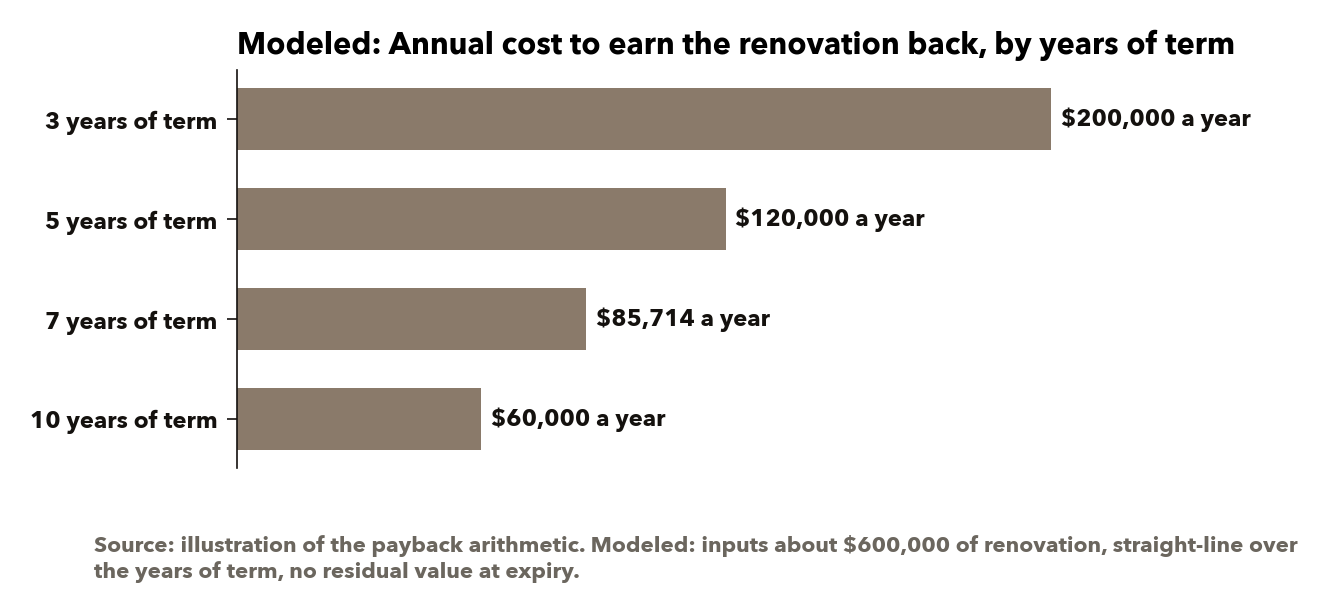
1. Secure the term. Known: the space was leased, the lease had come with the business, the building had just survived a fire. Unknown: whether the remaining term could carry a renovation. The question was what a landlord with a dark, damaged building would agree to before the room was rebuilt that he would never agree to after. It produced the lease extension. It changed the arithmetic of every dollar that followed. The strip below is the engagement's dated points; the figure after it is that arithmetic, illustrated across terms.
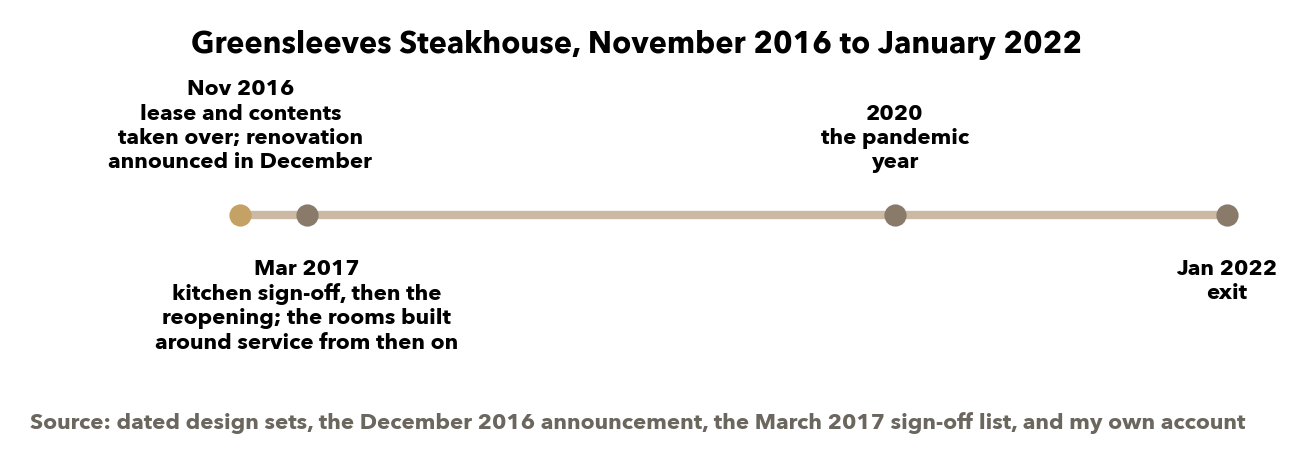
2. Phase the renovation around live service. Known: Tellus had the design sets drawn by mid-November 2016, and the renovation plan went to the local press on December 13. Unknown, and never priced against the alternative: whether one closed, clean renovation would have cost less than building around live tables. The question I asked was what a dark month cost in goodwill, and the answer was more than a crew working around dinner. The plan ran in two phases, and the first phase existed for one reason: to get the former staff back to work as soon as possible.
| Phase | What it covered | Why it came in that order |
|---|---|---|
| One: cosmetic, opened first | Minor changes toward a "modern vintage" feel; the kitchen and the health and fire sign-offs; the first floor serving | So the former staff had jobs to come back to, and the town had a room to come back to, before the big work started |
| Two: the rooms, built around service | The upstairs piano bar, the patio and rooftop bar with live music, the cigar lounge with a walk-in humidor, a private tasting area, the lounge and private event rooms | Each room was a new reason to come back, opened as it finished, while the restaurant kept earning |
3. Bring back the people who already ran it. Known: the former staff carried the regulars' trust. I rehired them rather than start with strangers, trading some retraining for speed and for the fact that the regulars already knew the faces. It changed how the reopening read in the local press: the town getting something back, not a new operator moving in.
4. Treat the reopening as a launch. Known: a restaurant that has been dark does not reopen on its own. I ran it like a campaign: press, a public relations push, and events for the city so the room filled with people who lived there and would come back on a Tuesday. The sequence was deliberate. Former staff first, because they are the trust. Press second, because the town has to hear it from someone other than us. Events third, because habit is built by repetition, not by one grand opening. The operator last, and that is the next step. Attachment B is that sequence as I would hand it to another operator.
5. Fix the plate, dish by dish. Known: the early reviews said what early reviews say, and two of them were specific. A scallop plate had gone out as three scallops on a puree at an entree price; a porterhouse had gone out thinner than the menu promised. We answered in public, as management, with the fix: the scallop plate rebuilt around four or five larger scallops on cauliflower and a beet and mango puree, the porterhouse moved to a thicker cut. That is what a builder does first with a restaurant, because the plate is the part of a restaurant a builder recognizes as the product.
6. Find the operator, not the concept. Known: the plate got fixed and the room still did not run the same on the nights I was not in it. We went through several chefs. Unknown at the time: whether the problem was the food, the room or the floor. The turn came with a general manager. The next section is about him.
7. Put food and labor on one weekly clock. Known: most restaurants review labor weekly and food cost monthly, which means the kitchen learns it lost money after it has lost it. I put both on the same weekly clock, timed to the purchasing cycle, so a bad week showed while it could still be corrected inside the pay period. The method is in the section on what we installed.
8. Keep it open through the pandemic, then exit. Known: by the time 2020 arrived the lease was long, the rooms were built, the general manager owned the floor and the clock was running. The rooms built in phase two included a patio and a rooftop, in a state that kept indoor dining closed for long stretches of that year. The question was whether to go dark and wait it out, or keep the doors open. I kept them open. We had bought this place because the town wanted it back, and it had already been dark once; the goodwill was the asset, and a second closing spends it. Keeping it open was not clean. I made tons of mistakes along the way, and they are mine, not the year's. I got my hands dirty. The restaurant traded through 2020 and 2021, and I exited in January 2022, at the standard on the cover.
The first thing I did was not spend a dollar. I went and got the lease extended, because a renovation on a short lease is a gift to the landlord.
The general manager, and what a standard looks like on a Tuesday
This is the part of the engagement I would tell a buyer first, because it is the part I got wrong for longest.
A builder looks at a restaurant and sees the product on the plate. When the room was rebuilt and the reviews were still uneven, I did what a builder does: I changed the person making the product. We went through several chefs. Each was a reasonable hire. Each fixed some dishes. None of them fixed the restaurant, and the reason took me too long to see. A chef owns the plate. Nobody owned the floor.
A standard in a restaurant is not the best night. It is the slowest night. It is a Tuesday in February with eleven covers, the owner at home, one server who would rather be somewhere else, and a regular at table four who has been coming since before the fire. On that night the food can be perfect and the restaurant can still fail, because the standard lives in whoever is watching the room, and if that person is the owner, the restaurant only works when the owner is in it. That is not a business. It is a job with better lighting.
The general manager who finally carried the turnaround was the one person who owned that Tuesday. What I saw in him was not a concept or a resume. He watched the room the way I would have watched it, and then he did it on the nights I was not there. He ran the floor and he reported to me; the standard was mine, the nights were his. He was the key guy, through me. Once he was in place, the chef question stopped mattering the way it had, because the kitchen was now being held to a standard by someone in the building every night.
That is the thread through this whole engagement, and it took me the longest to see: understanding the person, more than the brand, is what made it work. The brand was what we bought, a name the town already used, and it brought people through the door once. The former staff kept the regulars because the regulars knew them. The general manager held the room because he understood the people in it, the server who would rather be somewhere else and the regular at table four, better than any concept could. Every chef I hired was hired for the menu. He was the first hire I made for the person.
What it cost was time. Every chef change was a season of margin and a season of reviews. I do not print a number for that stretch because I would be inventing one; what I will say is that the operator search took longer than it should have, and that someone with a restaurant background would have gone to the floor before the plate. I went to the plate first. The lesson transferred, and I have used it since in businesses that have nothing to do with food: when the obvious fix has been made and the thing still does not work, stop hiring another version of the product and find the person who owns the standard.
The guests kept the record of that standard themselves, in public, and the older reviews are from the years I ran it: the restaurant's Yelp listing, its Tripadvisor page and its OpenTable page.
What it produced
The result on the cover is the one figure a reader could check. The shape behind it, from reopening to exit, is drawn below as a modeled line with a single sourced endpoint. The reopening was in 2017, the business reached its exit-year level within about two years, and 2020 is drawn as a band, not a value, because a modeled pandemic year would be a fiction dressed as a measurement.
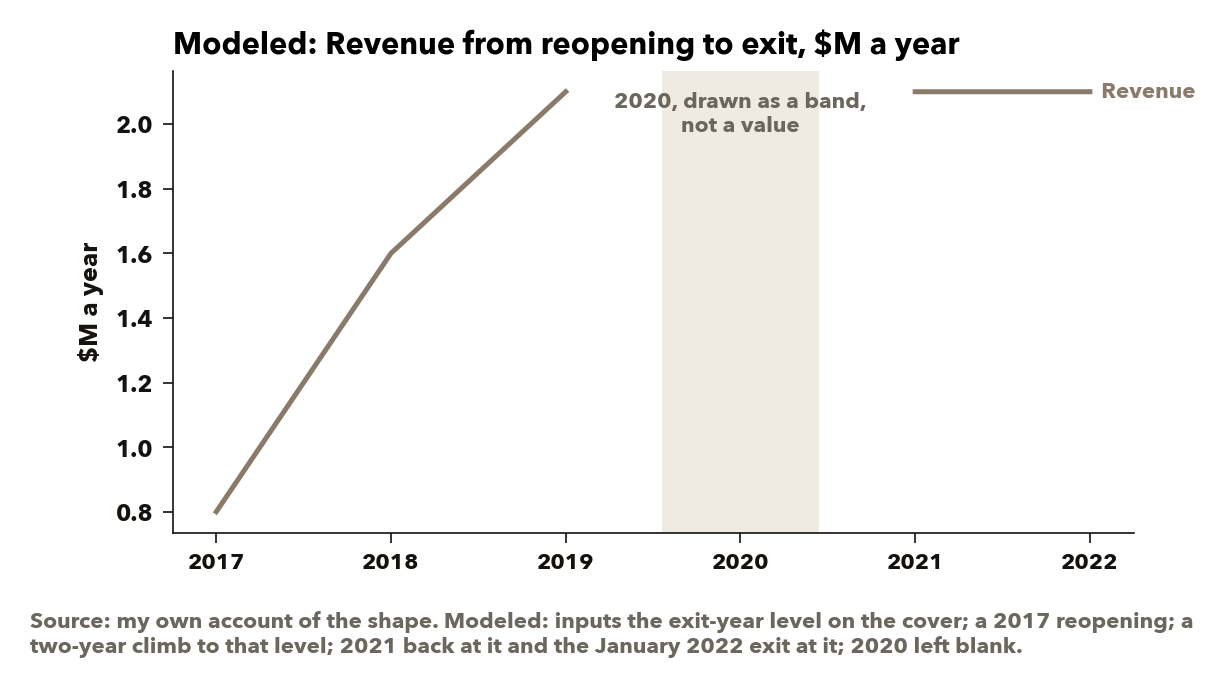
Two things a buyer should take from the shape rather than the number. First, the climb was front-loaded by the launch: the campaign and the former staff filled the room before the operating discipline existed to keep it full. Second, the restaurant stayed open through a pandemic on a leased space and came back to its level, which is the strongest evidence I have that the sequence was right: the term was long, the rooms existed, the operator was in place, and the clock was running before the test came. None of that made the pandemic years easy. It made them survivable, and the rest was work.
The restaurant is still serving under the name, and still posting on its Facebook page.
What we kept, replaced and installed
We kept the kitchen, the bar and the people. The operation itself we rebuilt, because there was nothing to inherit: the prior operation had failed, we never had its books, and my working read, never a measured figure, was that a wide, chef-driven menu pricing full plates below what the ingredients and labor cost was the more likely leak than a shortage of customers. The two things we installed answer that read.
The weekly clock
Food cost and labor cost on one weekly review, every Monday for the prior week, timed to the purchasing cycle so the correction lands inside the same pay period.
| Check | Cadence | Trigger |
|---|---|---|
| Labor as a share of sales | Weekly | Above the top of the labor band triggers a schedule review before the next week is posted |
| Overtime hours by role | Weekly | Any overtime outside a banquet or private event triggers a scheduling review |
| Covers per labor hour | Weekly | A declining trend over three consecutive weeks triggers a floor staffing review |
| Food and beverage purchases against sales | Weekly, with the order | Purchases above the food band for two weeks running trigger a menu mix review, item by item |
The logic that had to change: a monthly profit and loss tells a restaurant it lost money after it has lost it. A week is the shortest period in which a schedule can be rewritten and an order can be cut, so a week is the clock. Attachment D is the template.
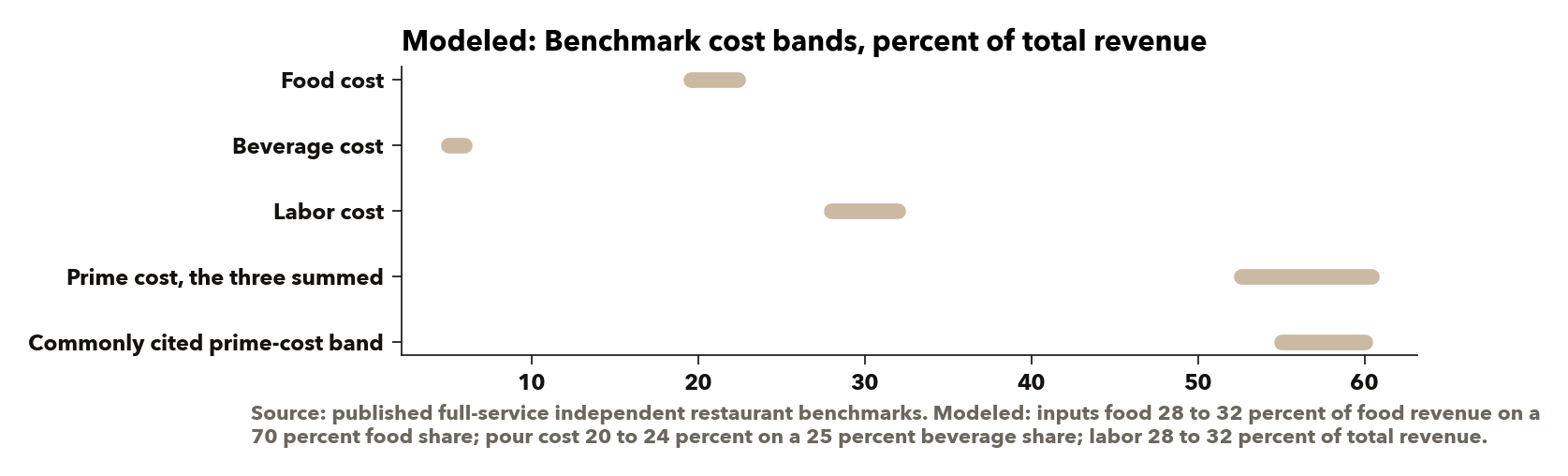
The bands the clock runs against are industry benchmarks for a full-service independent steakhouse, not this restaurant's own measured figures, and the chart below is a plausibility check on the model rather than a claim about the business. Food at the benchmark share of food revenue, pour cost at the benchmark share of beverage revenue, and labor at the benchmark share of total revenue, summed, give a prime cost that spans the commonly cited band on both sides rather than sitting inside it. That is the point of drawing it: the benchmark ratios for this kind of restaurant span the normal band, and the actual figures Greensleeves ran are the operator's, not this report's.
The second installation was the menu itself, run through the contribution margin and popularity matrix that Kasavana and Smith published in the 1980s and every serious restaurant still uses in some form. Every item is compared against the menu's own average contribution margin and its own average unit sales, and lands in one of four cells. The method is the diagram; the cells are what you do about each one.
| Popularity above the menu average | Popularity below the menu average | |
|---|---|---|
| Margin above the menu average | Star. Protect the price, never discount, keep it featured, buy for it first. The center-of-plate steaks lived here. | Puzzle. Worth selling and not selling enough: move it on the menu, teach the servers to sell it, do not touch the price yet. The bar program lived here until placement fixed it. |
| Margin below the menu average | Plowhorse. People want it and it does not pay: re-engineer the plate cost or reprice, but keep it for the traffic it brings. The shareable appetizers lived here. | Dog. Remove it. Sell through the case stock as a one-time feature and take its ingredients off the purchasing list. The legacy full-plate entrees carried from the prior operation were the candidates. |
The matrix decides what to sell. What decided whether a night made money was the walk-in cooler, so the purchasing rule was tied to it. For every ingredient the order trigger is the lesser of two quantities: the remaining shelf life in days times average daily units, and the supplier lead time in days times average daily units plus a safety stock. For anything perishable the shelf-life term is the one that binds, and that is deliberate: capping the order at what the shelf life can hold accepts a higher chance of running out of a short-life item in exchange for a lower chance of throwing it away, and spoilage, not stockouts, was the failure being fixed. Fast-moving ingredients that keep two weeks were held at two weeks of cover, so the purchasing signal and the weekly review ran on the same clock. Slow-moving, short-life ingredients, including the chef's features, were bought against confirmed reservations or a capped nightly allocation and never held as standing stock. Sides went a la carte, priced on their own, so portion and waste were controlled directly instead of buried in a fixed plate price.
What it cost to hold the line, and what I would watch
Getting the term first meant negotiating with a landlord before I had anything to show him, from the weakest position I would ever hold on that lease. Phasing the renovation meant a construction crew and a dinner service sharing a building for as long as the second phase ran, which is a daily tax on both. Backing one operator meant living with his calls on the nights I was not there, and eating the ones that went wrong, because a general manager who is second-guessed from home is not a general manager. Going to the plate before the floor cost the seasons I described above. And keeping the doors open through 2020 and 2021 cost what it costs to run a restaurant in a year nobody had run one in before: mistakes made in public, fixed in public, with my own hands in the work.
None of that is a complaint. It is the price of the sequence, and I would pay it again on the same information, with one change: I would go to the floor first.
What I would watch, in a business like this one or in any business where the product is a person's standard:
- The term before the money. Whenever the thing being improved is not yours, the right to occupy is the asset. Buy the term before the improvement, from the weak position, because the strong position never arrives.
- The slowest night, not the best one. Judge the operator by a Tuesday. If the standard only holds when the owner is in the building, the business has not been built yet.
- The clock. Any cost that is reviewed after it can be corrected is not being managed. Put food and labor on the shortest period in which a schedule and an order can change.
- The cooler over the menu. In a perishable business the order decides the margin before the guest sits down. Tie the purchasing rule to shelf life first and lead time second, and accept the occasional stockout.
- The operator search. When the obvious fix has been made and the business still does not work, stop hiring another version of the product. Find the person who owns the standard, then back him.
I learned a lot about the restaurant business in those few years. Most of it was not about restaurants. The brand brought the town back once. The people kept it coming: the staff who knew the regulars, the general manager who owned the Tuesday, the regular at table four. Understand the person before the brand. It is the first thing I look for now, in every business I walk into.
The result, in short
About $2.1M a year at a 4.8 star standard by the time I exited in January 2022, after keeping it open through COVID. The reopening reached that level within about two years, and the restaurant came back to it again after the pandemic. The lease extension and the phased build carried the room; the general manager carried the standard on the nights I was not there.
A slice of the project list
A few related projects.
- AXT Axe Haus: owner and operator of an axe throwing venue, entitlement fight and a long-term position (2018 to present)
- Sublime Medical: fractional Chief Operating Officer, a medical aesthetics practice (2015)
- Contractor Gorilla: advisor with an equity position, a marketing agency built for contractors (2014 to 2017)
- Santa Monica House: Chief Executive Officer, Tellus Design and Build, a custom home for a private homeowner (2020)